

Rental Car Inspection in Morocco: How to Avoid Disputes
A practical guide to inspecting your rental car at check-in and check-out in Morocco, so every existing defect is recorded in writing and disputes are easier to avoid.
A rental car inspection protects the renter (the customer) just as much as the rental company, meaning the agency. Carried out at pickup (check-in) and when the vehicle is returned (check-out), this process records the vehicle's condition in writing at two specific moments. Without this document, it becomes hard to prove that damage was already there before you drove off.
This guide is for anyone renting from professional agencies in Morocco: tourists, Moroccans living abroad, business travelers and local residents. The practical terms (deposit, insurance, fuel, mileage, excess, dispute procedure) vary from one agency to another, so check the written offer and contract before signing. Here you will find the steps, a checklist, an inspection table and a message template so you can approach your car rental in Morocco with peace of mind.
RentalMe connects renters with professional rental agencies; RentalMe does not own the vehicles and is not the agency. The platform is in pre-launch: the waitlist is not a reservation.
Understanding the rental car inspection: check-in, check-out and responsibilities
An inspection is a visual check of the vehicle, recorded in a written report at a given moment. A thorough inspection covers both the exterior and the interior of the vehicle. It should be carried out before and after the rental, so twice: before the keys are handed over (check-in) and at the time of return (check-out). The comparison only makes sense if both checks are done with the same care.
Key points to remember:
- At pickup, the inspection records existing defects: every scratch, dent, chip, stain or missing part must be written on the form.
- At return, the agent compares the vehicle's current condition with the original document and the photos taken at pickup.
- What isn't written down is hard to prove. If an existing defect is not noted at pickup, the agency may consider that it appeared during your rental. How you are held responsible depends on the contract you signed.
- A joint inspection is carried out with both the renter and the agent present, signed by both parties, with a copy handed over (paper or PDF).
Each agency follows its own procedure: paper form, tablet or app. Ask which one before pickup.
Rental car inspection checklist: the steps at pickup
First tip: don't rush, even if the rental agent is in a hurry. Allow enough time to inspect the vehicle, outside and inside, before leaving the airport or the agency.
Keep these with you: the rental contract (printed or PDF), your ID, your driving license and the documents the agency requires for the deposit.
Bodywork: walk all the way around (front, rear, sides, roof, sills). Every scratch and dent must be noted, even the smallest ones.
Windows and mirrors: check the windshield, side windows, rear window and mirrors (housing and glass) for any chips or cracks.
Wheels and tires: check each wheel rim (scuffs, dents) and the tire sidewalls (cuts, bulges, visible wear).
Headlights and lights: test the low beams, turn signals and brake lights. Also look at the warning lights on the dashboard when you start the engine.
Interior: seats, dashboard, floor mats, headliner, seat belts. Note how clean it is and any odors. Test the air conditioning, the radio and the USB ports.
Mileage: write down the exact odometer reading and check what the contract provides (mileage allowance or unlimited mileage).
Fuel: note the fuel gauge precisely (full, ¾, ½) and check that it matches the written report and the contract's fuel policy.
Equipment: check that the safety equipment and accessories supplied by the agency are present (warning triangle, high-visibility vest, jack, spare wheel or repair kit, keys).
Documents on board: check with the agency which vehicle documents must be kept on board, and make sure they are there.
Every defect you spot must be added in writing to the vehicle condition report before the keys are handed over. A verbal comment is not proof in a dispute: unless the form says otherwise, the rental company may consider that the vehicle was handed to you without any defects.
Practical table: vehicle condition report at pickup and return
This table sums up what to check at check-in and check again at check-out. Keep it handy for when you return the vehicle.
| Item | At pickup (check-in) | At return (check-out) |
|---|---|---|
| Bodywork | Note every scratch, dent and chip on the form | Compare with the original form; discuss any new item |
| Windows and mirrors | Photograph existing chips and cracks | Check again; compare with the pickup photos |
| Wheels and tires | Check rims for scuffs and tire sidewalls | Check each wheel and tire again |
| Interior | Describe stains, burns, broken parts | Check cleanliness; compare with the original description |
| Mileage | Write down the exact reading; compare with the contract | Write down the new reading |
| Fuel | Note the exact level | Return it at the level set in the contract |
| Equipment | Tick off triangle, vest, spare wheel, jack, keys | Confirm everything is there |
| Remarks | Write down every defect, even minor ones | Add your observations; don't sign an inaccurate report |
| Copy | Get the signed form | Get the signed return form |
Photos and videos: your best evidence in a dispute
Taking photos of the vehicle is essential to avoid disputes, because a written form alone leaves room for interpretation. An inspection without photos can expose you to unjustified charges. Take them from different angles to cover every side.
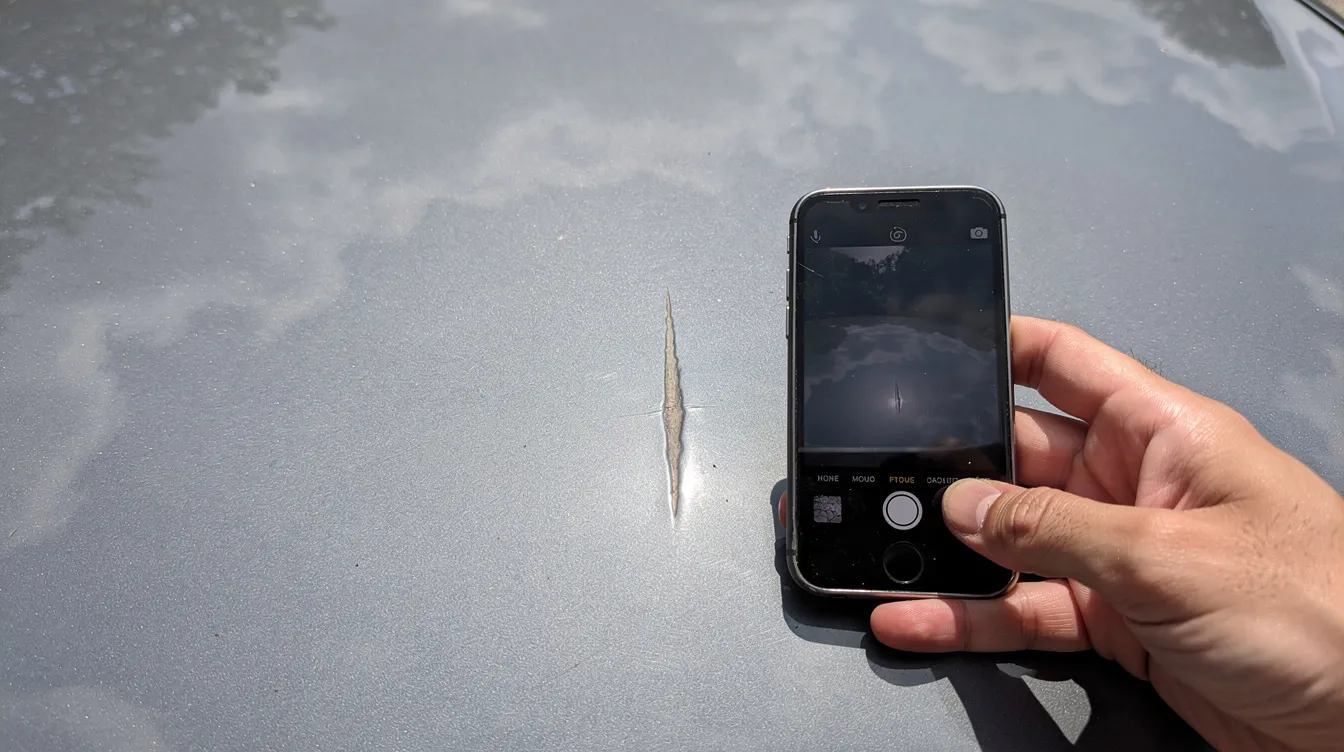
What to capture at pickup and at return:
- wide shots of the whole vehicle (front, rear, right side, left side);
- a photo of each wheel;
- close-ups of every defect (scratch, chip, dent, stain, burn);
- a photo of the dashboard with the ignition on, showing the mileage, fuel level and any warning lights;
- a short video walking around the vehicle.
Do the inspection in good light, in the agency's parking lot, before leaving. Dated photos help prove the vehicle's condition: the date and time recorded by your phone place your photos in time; also send them to the agency by email or message to create a written record. Keep them at least until the deposit has been released and no invoice remains outstanding.
Some agencies take their own photos with an app or a tablet. Take your own shots as well: they remain available to you if a problem comes up at the end of the rental.
Practical tips: the vehicle's sensitive spots
Some areas account for many of the issues raised at return and deserve a particularly careful look:
- Bodywork: sills, bumpers, door handles, around the trunk. Have every visible micro-scratch recorded, even if it seems "unimportant".
- Tires and wheels: a cut in the sidewall or a rim scraped against a curb is easy to miss.
- Windows and mirrors: a small chip in the windshield must be noted at pickup.
- Interior: burns, stains, tears, broken controls. Test the air conditioning, especially for a summer road trip.
- Equipment: triangle, vest, jack. Losing an accessory or a key may result in charges depending on the contract.
Deposit, credit card and insurance: what's at stake during the inspection
Many agencies ask for a deposit at pickup; the method (a hold on a credit card or another means) and the amount depend on the agency. The deposit serves as a guarantee for the rental company: a deduction may be applied for any damage or charges found at return, according to the rules of the contract. Ask on what basis an amount may be withheld and how it will be justified to you.
The deposit amount, the release time, the excess, the insurance options, their exclusions and the charges for new damage are set by the agency's contract. Read these clauses and ask for them in writing before signing. Insurance may be included in your rental contract and cover part of the repair costs, depending on its terms and exclusions. Review the insurance options offered by the rental company: additional coverage may be useful depending on your situation, but compare what it actually covers before taking it out. Some credit cards may include car rental coverage: check directly with your bank, as this is not automatic.
Also ask in writing for the procedure if damage is found at return: how it is described, how its cause is discussed, how the invoice is drawn up and within what timeframe. Knowing these rules before you leave avoids unpleasant surprises at the end of the rental. RentalMe does not set these terms; each agency remains responsible for its own policies.
Message template: asking the agency about its inspection procedure
Send this message to the rental company by email or WhatsApp before confirming your rental; keep its written replies with your contract:
Hello,
I am planning to rent a car from your agency for [dates]. Before pickup, could you please confirm in writing:
- Is the inspection at pickup carried out in my presence? On paper, a tablet or an app?
- Is the check at return carried out with me?
- What are your return hours, and what is the procedure if I return the car outside those hours?
- How will you send me the vehicle condition report (paper, PDF, other)?
- What are the amount, method and release time of the deposit, and what is the procedure in case of damage?
Thank you for your answers to these questions. Kind regards, [Your name]
Returning the vehicle: getting the check-out inspection right
Arrive early for your scheduled return time, especially at the airport, so you have time to do the check without stress.

Before you show up:
- return the interior clean (no trash or sand); cleaning fees may apply if the vehicle is returned very dirty, depending on the contract;
- follow the contract's fuel policy;
- park the vehicle in the designated return area and wait for the agent.
Usual check-out steps:
- exterior and interior inspection, compared with the pickup form;
- reading of the mileage and fuel level;
- check of the equipment;
- discussion of any additional damage found.
If you disagree with the rental company, don't sign a document that doesn't reflect what you observed. Add your written remarks if the agency allows it and take your own photos again on the spot. Get a copy of the return inspection report before leaving: without this proof, any later claim becomes more difficult. The process is the same for every customer: individuals, business travelers or families.
Out-of-hours check-in and check-out: reducing the risks
Late flight, very early departure, agency closed: returning a vehicle outside opening hours prevents a joint inspection and makes recording its condition harder for both parties.
In that case:
- take photos and videos of the vehicle parked at the designated spot;
- photograph the parking space and the dashboard (mileage and fuel);
- send these to the agency immediately to create a dated written record.
The procedure to follow is set by the agency: ask for it in writing before picking up the vehicle.
Preparing your rental with RentalMe and joining the waitlist
RentalMe is a Moroccan marketplace in pre-launch that connects renters with professional rental agencies. RentalMe does not own the vehicles and does not guarantee availability or terms: these are set by each agency.
To prepare for your next trip, see the checklist for planning a Morocco road trip in 2027 and the guide to choosing between airport pickup or city collection.
FAQ: common questions about rental car inspections
Should I do the inspection with the agent at pickup?
Yes, it is strongly recommended. Without a report signed by both parties, it is hard to prove that a defect existed before your rental. Take your time, even if the agent seems to be in a hurry.
What should I do if I'm not offered a written inspection report?
Ask for one. Failing that, take your own photos from every angle and send them to the agency with a description of the defects. Then decide whether you want to go ahead under those conditions.
What should I do if the agency reports damage after the return?
Ask for a written report specifying the damage, its location and the invoice. Compare it with your photos and your copy of the return form. The terms for disputing it depend on the contract signed with the agency.
How long should I keep the photos?
At least until the deposit has been fully released and no invoice remains outstanding.
Does my credit card protect me in case of damage?
That depends on your bank and your card. Check the exact coverage and the steps to follow with your bank before you leave.
Can I refuse to sign an inaccurate return inspection report?
You can refuse to sign a document that doesn't reflect reality. Add your written remarks if possible and keep your photos. The consequences depend on the contract: read the return clauses before picking up the vehicle.
What should I check in the contract before taking the keys?
The deposit (amount, method, release time), the excess, the insurance options and exclusions, the fuel policy, the mileage, and the return and damage procedure.
You can join the RentalMe customer waitlist. Signing up is not a reservation.